
GOLIAT study used four anatomical models (two adults and two children) to simulate RF-EMF absorption across 15 frequencies from 450 MHz to 26 GHz
The child models showed 1.5–1.9 times the whole-body absorption per kilogram of the adult models at frequencies below 6 GHz
The exposure levels measured in current 5G networks remain several orders of magnitude below the reference levels used in the simulations
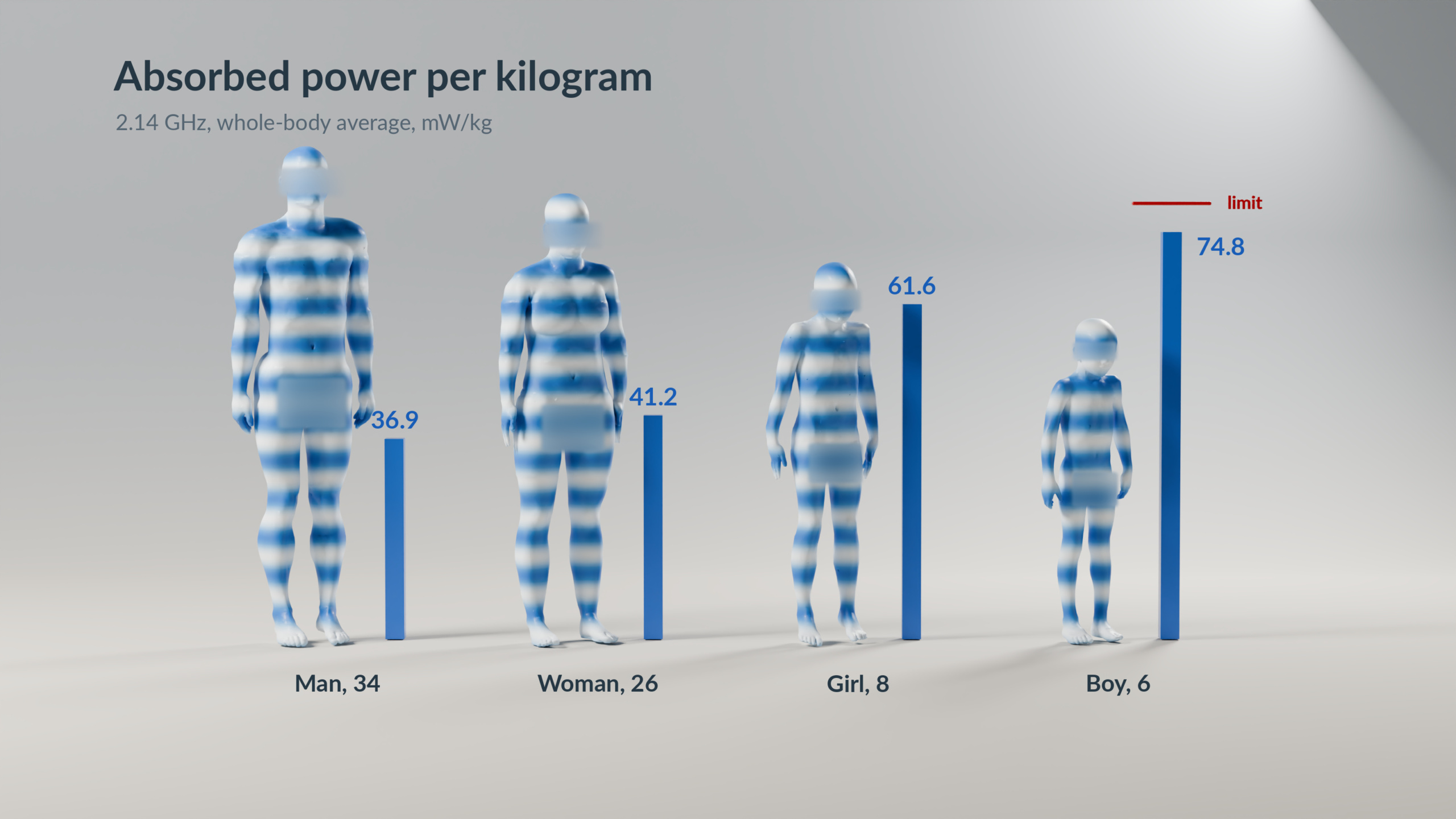
Four anatomical models from the study, with whole-body absorbed power per kilogram at 2.14 GHz and an external exposure of 10 W/m². The red marker indicates the 80 mW/kg whole-body limit. Values are averaged across the 12 simulated directions and polarisations. The blue stripes are illustrative and do not show local absorption. The simulated exposure level is much higher than typical exposure measured in everyday scenarios.
Credit: WAVES research group, Ghent University, imec. Anatomical models: Virtual Population, IT’IS Foundation.
A new study from Project GOLIAT, led by researchers at Ghent University and imec, has used computational simulations to investigate how radiofrequency electromagnetic fields (RF-EMF) are absorbed by the human body across a wide range of frequencies used by current and future wireless communication systems. The results show how body size, frequency and beamforming affect absorption. The study fills gaps in exposure data for children at higher frequencies and makes its results and simulation tools available for other researchers to use.
Published in Physics in Medicine & Biology, the study performed 550 simulations using four detailed anatomical models, known as phantoms: two adults and two children aged six and eight. The researchers examined 15 frequencies between 450 MHz and 26 GHz, covering frequencies used by current 4G and 5G networks, as well as bands considered for future 6G networks.
The study considered two different exposure scenarios. The first represented environmental exposure, in which RF-EMF reaches the body from different directions. The second simulated auto-induced exposure, which occurs when a base station uses beamforming to direct a signal towards the device of an active user. Beamforming is increasingly used in modern mobile networks to concentrate radio signals towards the devices that need them rather than transmitting uniformly in all directions.
Children show higher whole-body absorption below 6 GHz
At frequencies below 6 GHz, the simulations showed that the two child models had whole-body specific absorption rates (SAR) 1.5–1.9 times those of the adult models. SAR measures the rate at which RF-EMF energy is absorbed per kilogram of tissue. According to the researchers, this difference is largely explained by children’s higher ratio of absorption cross-section to body mass.
The difference was most relevant around 2 GHz. At 2140 MHz, when exposure was set at the reference level recommended by the International Commission on Non-Ionizing Radiation Protection (ICNIRP), the six-year-old model reached 93% of the whole-body basic restriction when results were averaged across the different exposure directions. In the most unfavourable simulated orientation, both child models exceeded the whole-body basic restriction, while the adult models remained below it in every configuration.
These simulated conditions should not be interpreted as representative of typical real-world exposure. The study notes that measurements from deployed 5G networks have found environmental exposure levels three to four orders of magnitude below the ICNIRP reference level used to normalise the simulations. At the highest environmental level reported in that measurement campaign, even the most unfavourable simulated configuration for the six-year-old model would remain around 4,000 times below the corresponding basic restriction.
Higher frequencies shift absorption towards the body surface
The simulations also illustrate how the location of RF-EMF absorption changes as frequency increases. Lower frequencies penetrate further into the body, whereas at higher frequencies energy is increasingly absorbed in superficial tissues.
In the six-year-old model, with the external exposure held constant, brain SAR decreased by 96% between 450 MHz and 5.8 GHz, while skin absorption increased as penetration depth became shallower. At still higher frequencies, the same pattern was observed in the eyes: eye SAR decreased 77-fold between 7 and 26 GHz as penetration depth became smaller than the thickness of the eyelid.
The study also covers frequencies where data on children have been scarce. According to the authors, it is the first study to perform whole-body dosimetry at 26 GHz in both child and adult phantoms and to characterise absorbed power density in children across the 7–15 GHz range.
Beamforming simulations identify scenarios exceeding basic restrictions
In the beamforming simulations, absorbed energy was redistributed towards particular areas of the body without increasing the total energy absorbed. At 3.5 GHz, local SAR exceeded the corresponding ICNIRP basic restriction by 31–58% in all four anatomical models when the simulated incident exposure was set at the ICNIRP whole-body reference level. At 7 GHz, absorbed power density in the six-year-old model was 2.5% above the basic restriction, a difference within the study’s estimated uncertainty.
Reference levels set limits on the radiofrequency fields outside the body. They are designed to let exposure be assessed by just measuring these fields. Basic restrictions limit absorption inside the body. The simulations identify conditions where absorption exceeds the basic restrictions even when exposure is set at the reference level.
At the network exposure levels cited in the paper, even the highest estimated absorption in children would remain far below the limits.
“Our findings suggest that compliance assessment may need to account for factors such as beamforming and body size, particularly as new frequency bands are considered for future wireless networks. For example, our results indicate that assessments in the 7.125–8.4 GHz band should include child anatomical models,” says Robin Wydaeghe, first author of the study and researcher at Ghent University.
Improving exposure assessment for current and future networks
“Beyond assessing compliance, these simulations provide organ-specific absorption estimates for the brain, eyes, skin and genitals across a broad range of frequencies. These data can help improve exposure assessment in epidemiological studies investigating the potential long-term effects of RF-EMF exposure,” says Robin Wydaeghe.
The authors stress several limitations. Only four anatomical models were included, limiting the ability to capture variability across the population. The 26 GHz analysis was limited to the six-year-old model and a single incidence direction due to computational demands, while the beamforming simulations represented a simplified scenario rather than the complex propagation conditions found in real environments. Future studies incorporating additional child models, different body postures and more realistic propagation scenarios could further refine these estimates.
Open-source software to automate RF-EMF exposure simulations
The simulations used in the study were performed with GOLIAT, an open-source Python framework developed by Robin Wydaeghe at Ghent University as part of Project GOLIAT. The software was created to automate electromagnetic exposure studies performed with Sim4Life, reducing the need to manually configure and process large numbers of simulations.
Using a JSON configuration file, researchers can define anatomical models, antennas, frequencies and exposure scenarios. GOLIAT then automates the workflow, from building the simulation scenes and computational grids to running the simulations, extracting the results and generating plots. The framework supports both near-field and far-field exposure studies and allows configurations to be reused and shared, making computational studies easier to reproduce.
The software was used to run the 550 simulations included in the present study and placed third in the Sim4Life Student Competition. It is freely available as open-source code. Running the simulations requires a Sim4Life licence.
Access the GOLIAT code
Read the documentation
Get started with GOLIAT
Access the study data and simulation configurations
Reference
Wydaeghe R, Stroobandt B, Gallucci S, Parazzini M, Tognola G, Wiart J, et al. Environmental and auto-induced RF-EMF adult and children far-field exposure simulations between 450 MHz and 26 GHz. Physics in Medicine & Biology. 2026;71:175006. doi:10.1088/1361-6560/ae97ac.

 #ProjectGOLIAT
 Linkedin