
A study led by Swiss TPH and published in Environmental Research measured personal RF-EMF exposure in 143 Swiss adolescents
WiFi and Bluetooth account for the largest share of adolescents' daily RF-EMF exposure
Exposure was highest in transport systems and lowest at home and school
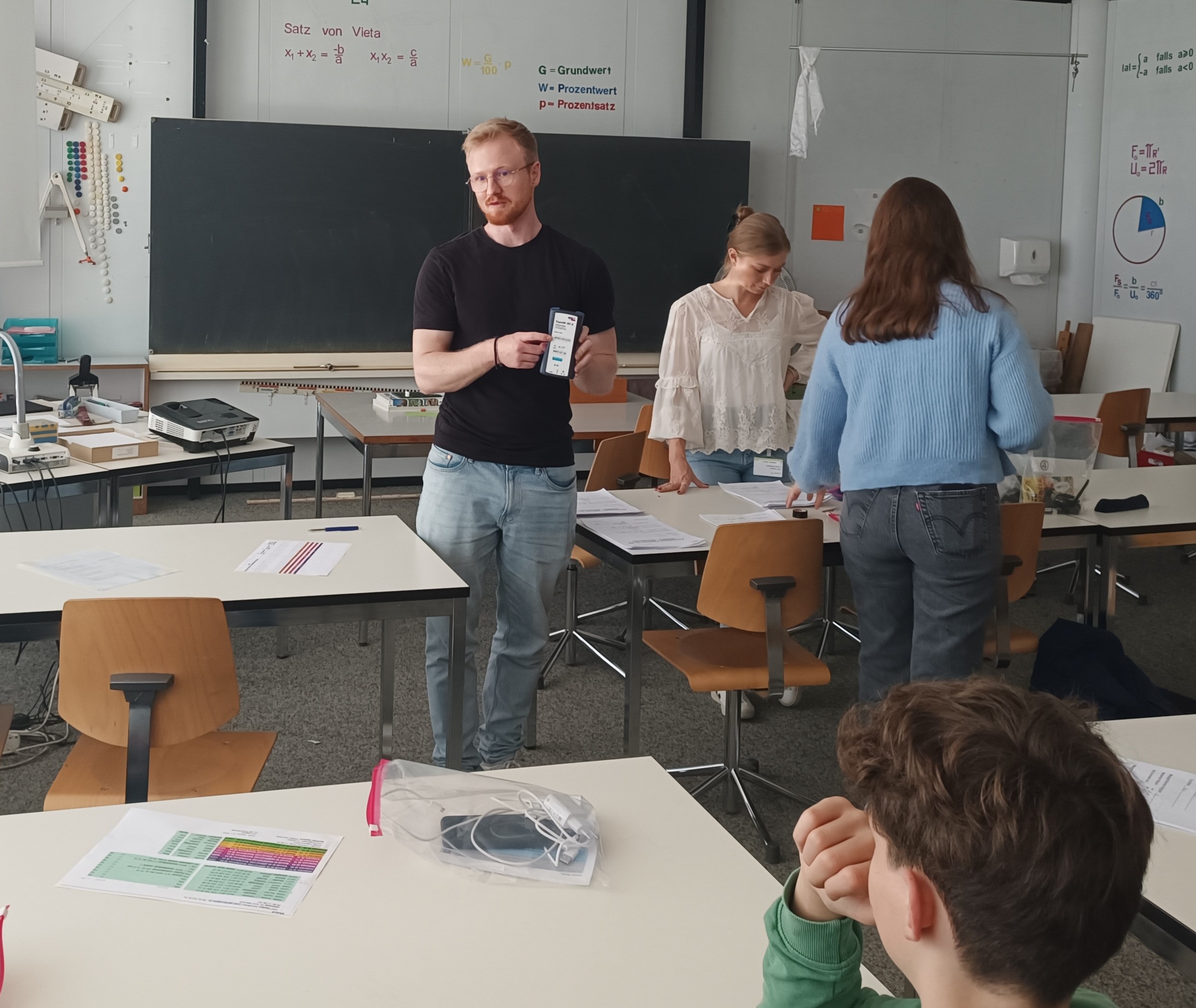
Swiss TPH researchers involved in Project GOLIAT instruct study participants on the use of the exposimeter for personal measurements during a school visit.
As 5G networks continue to expand across Europe, understanding how they affect people’s everyday radiofrequency electromagnetic field (RF-EMF) exposure has become increasingly important. A new study published in Environmental Research and led by the Swiss Tropical and Public Health Institute (Swiss TPH) within Project GOLIAT provides the first comprehensive assessment of personal RF-EMF exposure among adolescents after the widespread deployment of 5G in Switzerland.
The researchers monitored the daily exposure of 143 Swiss adolescents aged around 13.5 years using personal exposimeters over approximately 72 hours. The devices continuously measured exposure across 35 frequency bands while participants also recorded their daily activities, allowing the team to compare exposure across different environments such as home, school, transport and outdoor settings.
Despite the widespread rollout of 5G, the researchers found that overall personal RF-EMF exposure remains comparable to levels measured before the technology was introduced. Instead, everyday behaviours and the environments where adolescents spend their time appear to play a greater role in determining overall exposure.
The average daily personal RF-EMF exposure recorded in this study was 0.09 mW/m², very similar to the average levels measured in the two previous HERMES campaigns in Switzerland: 0.06 mW/m² in HERMES1 and 0.08 mW/m² in HERMES2. These findings indicate that overall personal RF-EMF exposure among Swiss adolescents has remained stable despite the rollout of 5G, although the relative contribution of different exposure sources has changed over time.
WiFi and Bluetooth now contribute the largest share of exposure
One of the study’s main findings is that WiFi and Bluetooth now account for the largest share of adolescents’ daily RF-EMF exposure, contributing around 35% of the total measured exposure. Broadcast services such as radio and television represented 31%, while mobile phone uplink signals accounted for 19%. Downlink signals contributed 10%, whereas the specific 5G Time Division Duplex (TDD) bands represented only about 4% of the total measured exposure.
“The widespread adoption of wireless technologies such as Bluetooth devices appears to have changed the composition of adolescents’ everyday RF-EMF exposure,” says Hamed Jalilian, researcher at Swiss TPH and first author of the study.
Exposure varies depending on where adolescents spend their time
RF-EMF exposure differed substantially across everyday environments. The highest levels were recorded while travelling on public transport, particularly trains, whereas the lowest exposures were measured at home and at school, in line with microenvironmental measurement studies conducted previously in the frame of GOLIAT. Exposure also tended to peak during the afternoon, reflecting periods of greater use of wireless communication technologies.
“Personal exposimeters provide an excellent picture of environmental RF-EMF exposure, but they cannot fully capture exposure from devices used close to the body, such as smartphones or wearable technologies. Combining these measurements with information on device use remains essential to accurately assess personal exposure,” says Martin Röosli, researcher at Swiss TPH and senior author of the study.
Reference
Jalilian H., Waibl VJ, Wipf I., Mootz I., Abend S., Sandoval Diez N., Fernandes Veludo A., Loizeau N., Dongus S., Guxens M., Röösli M., Personal radio frequency electromagnetic field exposure among Swiss adolescents in the 5G era. Environmental Research, Volume 304, 2026, 124775, ISSN 0013-9351, https://doi.org/10.1016/j.envres.2026.124775.

 #ProjectGOLIAT
 Linkedin