
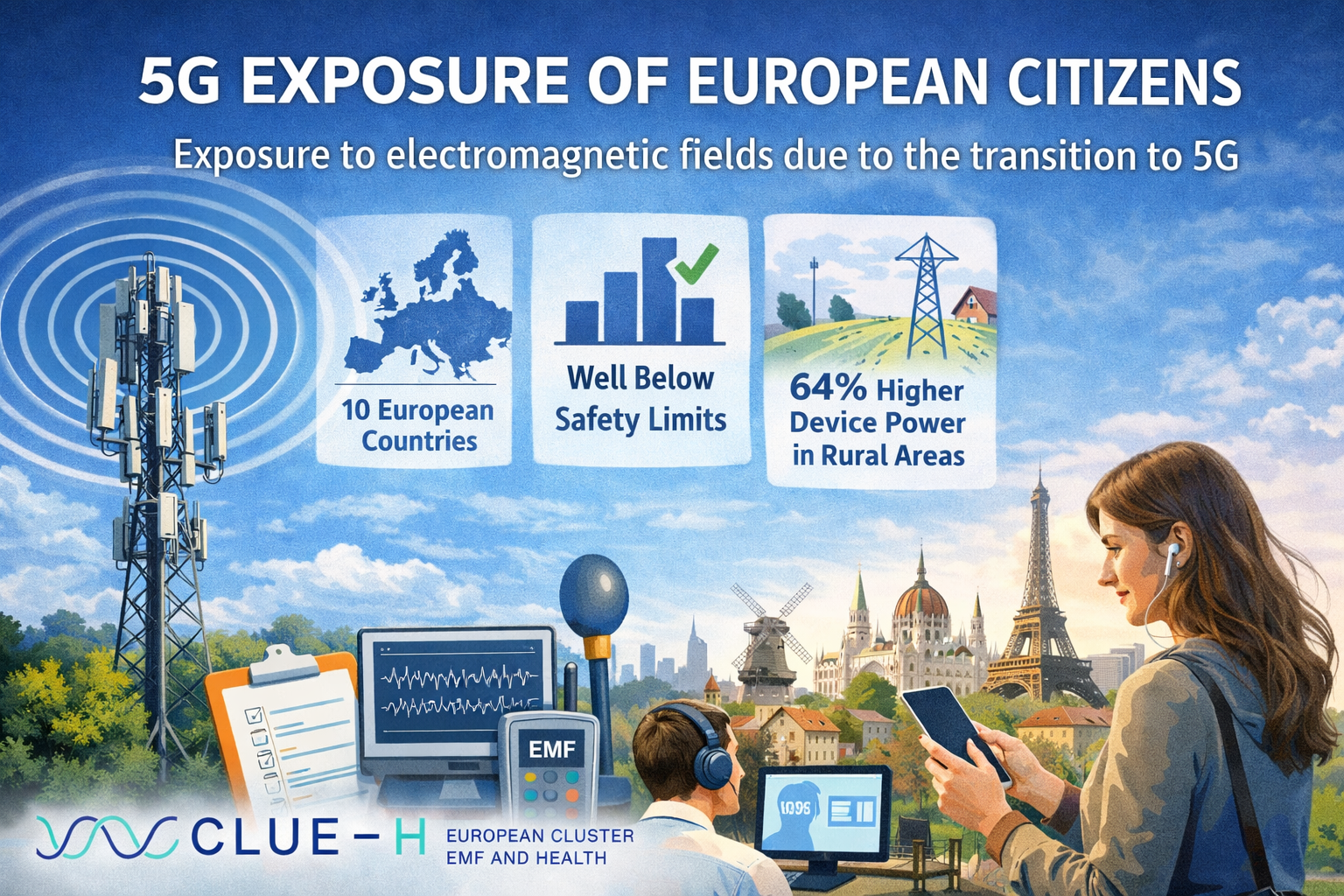
Research projects within the CLUE-H cluster show that 5G exposure levels remain well below safety limits
Findings highlight the importance of monitoring, network design and improved public communication
Large European measurement campaigns show no noticeable increase in environmental exposure with the rollout of 5G
A new policy brief published by the European EMF and Health Cluster (CLUE-H) summarises the latest scientific evidence on exposure to radiofrequency electromagnetic fields (RF-EMF) in the context of the rollout of 5G networks in Europe.
The document brings together results from four Horizon Europe research projects — GOLIAT, ETAIN, SEAWave and NextGEM — that are studying how the transition to 5G affects environmental exposure levels, how people perceive these exposures, and what the implications may be for public health policy.
Together, the projects provide one of the most comprehensive assessments to date of 5G exposure in real-world environments across Europe, combining measurement campaigns, behavioural research and technological analysis.
Understanding exposure in the 5G era
Human exposure to electromagnetic fields from mobile communications comes from several sources at the same time. These include signals from network infrastructure such as base stations, emissions from a person’s own mobile device, and signals generated by devices used by nearby people.
The introduction of 5G networks has changed some of these exposure patterns. New technologies such as beamforming and advanced antenna systems allow signals to be directed more precisely toward users. As a result, exposure can vary more rapidly over short distances and time periods than in previous generations of mobile networks.
Another important development is the introduction of higher frequency bands, including millimetre-wave frequencies. These higher frequencies interact mainly with superficial tissues such as the skin and eyes, and they require dense networks of low-power antennas. These technological changes make exposure patterns more complex and highlight the need for detailed measurement and modelling studies.
How Europeans perceive 5G exposure
The policy brief also summarises results from a large international survey carried out jointly by the SEAWave and GOLIAT projects, which examined how people in Europe perceive their exposure to electromagnetic fields from mobile technologies.
The survey included representative samples of around 1,000 respondents in each of ten European countries. Overall, participants tended to believe that their exposure to electromagnetic fields would increase with the introduction of 5G, even though they generally rated their current exposure as moderate.
Many respondents also expected that upgrading a mobile phone base station from 4G to 5G would increase exposure levels. Similarly, activities such as making video calls using a 5G smartphone were perceived as producing higher exposure than using 4G or Wi-Fi.
These results show that public perceptions of electromagnetic field exposure often differ from measured exposure levels, highlighting the need for clear communication and transparent information about wireless technologies.
Measuring exposure across Europe: the role of GOLIAT
One of the major contributions to the policy brief comes from Project GOLIAT, which has conducted extensive measurement campaigns across Europe to assess RF-EMF exposure in everyday environments.
Researchers carried out measurements in ten European countries — Austria, Belgium, France, Hungary, Italy, the Netherlands, Poland, Spain, Switzerland and the United Kingdom. Measurements were taken along predefined routes in urban and rural areas and under different scenarios representing typical mobile phone use.
The results show that environmental exposure levels are around 80% lower in rural areas than in urban environments, reflecting the lower density of telecommunications infrastructure outside cities. Across all countries and measurement scenarios, exposure levels were found to be well below the limits established by international safety guidelines.
The measurements also identified the main sources of exposure in different situations. Signals from base stations — particularly the 4G band around 1800 MHz — were typically the main contributors to environmental exposure when people were not actively using their devices. When mobile data traffic was generated, the 5G band around 3.5 GHz became a major contributor to exposure.
At the same time, the measurements showed that mobile devices may transmit at significantly higher power in rural areas, where network coverage is weaker. In the maximum uplink scenario analysed in the project, the transmitted power of devices was up to 64% higher in rural areas than in urban environments, likely because phones need to work harder to maintain a connection when the signal from base stations is weaker.
Network quality and personal exposure
The ETAIN project has investigated how network conditions influence exposure from mobile devices.
Researchers found that when signal quality is good, mobile phones tend to transmit at lower power levels. This means that personal exposure during device use may actually decrease in areas with strong network coverage, even though environmental signals from base stations may be more detectable.
This finding illustrates the complex relationship between network infrastructure, device behaviour and total exposure experienced by users.
Exposure patterns in everyday environments
The SEAWave project has studied exposure in a wide range of real-world environments, including shopping centres, transportation hubs and large public events.
Results show that exposure patterns vary depending on population density and network infrastructure. In rural areas, exposure from personal devices tends to play a larger role because base stations are located further away. In urban areas, where base stations are closer and more numerous, environmental exposure from the network becomes relatively more important.
As observed in other projects, device transmission power tends to decrease when signal conditions are good.
Early measurements of higher-frequency 5G systems
The NextGEM project has focused on measuring exposure in higher-frequency 5G systems, including millimetre-wave deployments.
Because these systems are still relatively rare in Europe, researchers conducted targeted measurement campaigns in experimental and commercial environments. Initial results indicate that exposure levels remain well below international safety limits, even in situations where advanced antenna systems direct signals toward active users.
Measurements also show that exposure levels drop rapidly when a person moves away from the focused signal beam.
Key conclusions for policymakers
Taken together, the findings from the CLUE-H projects point to several important conclusions.
Large measurement campaigns conducted across Europe show that environmental exposure levels remain well below regulatory limits, and that the rollout of 5G has not led to noticeable increases in environmental RF-EMF exposure.
The research also highlights that a person’s total exposure depends strongly on how devices are used, including the duration of use and the distance between the device and the body.
At the same time, the studies underline the importance of continuing to monitor exposure levels as wireless technologies evolve and new frequency bands are introduced.
The policy brief also recommends that exposure considerations should be taken into account early in the development of new communication technologies and that improved communication strategies are needed to address public concerns and misconceptions about electromagnetic fields.
For more information, read the full CLUE-H policy brief on RF-EMF exposure and 5G networks.

 #ProjectGOLIAT
 Linkedin